


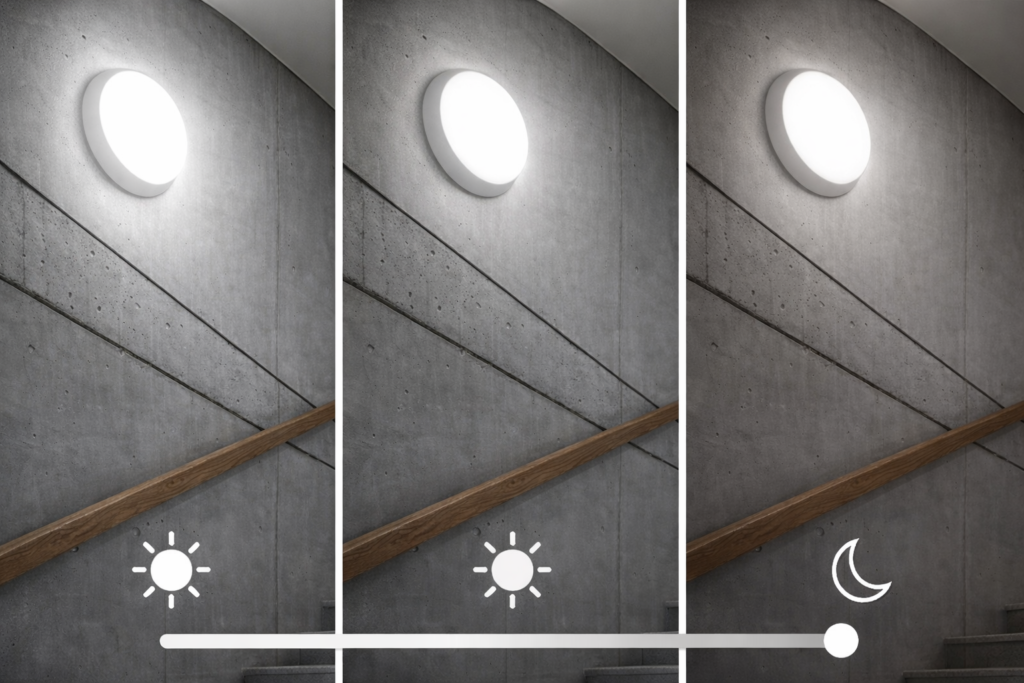
- 1. What is Dimming?
Dimming refers to the ability to adjust the brightness of a light source by controlling the amount of electrical power it receives. In simple terms, it’s the process of reducing the light output (measured in lumens) from a lamp or luminaire.
Technically, dimming can be achieved through different control methods. The most commonly used include DALI, switch (push), 0/1–10V analogue and mains TRIAC. New technology now offers wireless dimmable control, via Bluetooth.
Different types of dimming and how they work
DALI
DALI (Digital Addressable Lighting Interface) is a widely used digital lighting control protocol designed for flexible and intelligent management of lighting systems.
DALI protocol supports two-way communication, therefore it can not only control lights but also receive feedback—such as fault
reports or operating status from each individual luminaire. The wiring is simple and does not require special shielding, making it suitable for a variety of layouts.
Overall, DALI provides precise, programmable, and centralised lighting control, making it the preferred choice for commercial and architectural e
nvironments that demand advanced functionality and system monitoring.
Switch (Push)
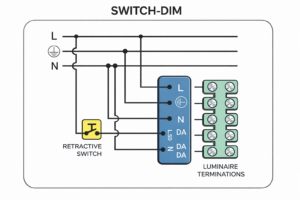
Switch dimming (also known as push or touch dimming) offers a straightforward digital control solution using a standard retractive “push-to-make” switch.
This system provides a user-friendly and cost-effective way to
control lighting levels without complex wiring or software.
In commercial or office settings, push dimming is highly valued for its convenience and versatility, enabling quick adjustment of ambience—from bright working conditions to softer lighting for presentations or relaxation.
Wireless Dimming
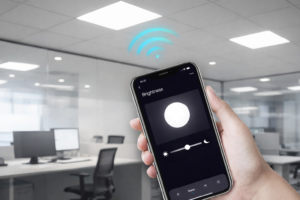
Wireless dimming allows you to control the brightness of a light fixture without any additional physical control wiring.
A wireless controller or smartphone app sends a signal, which is received by a built-in wireless module / node inside or remotely connected to the luminaire. The luminaires driver then adjusts the output, accordingly, increasing or reducing brightness.
Wireless dimming can also integrates seamlessly with smart home or smart building systems, enabling scenes, schedules, automation, and voice control for added convenience.
- 0/1-10V Analogue
0/1–10V dimming is one of the earliest forms of dimming protocols.
It uses a DC voltage signal that varies between 0/1 and 10 volts to control brightness.
- At 0V, the luminaire is totally off
- At 1V, the luminaire operates at its minimum output.
- At 10V, the luminaire operates at its maximum output.
This method requires a separate control signal to communicate with the LED driver and adjust the dimming level. While simple and reliable, it’s a one-way communication system, meaning it can’t send feedback to a central controller.
TRIAC Dimming
TRIAC (Triode for Alternating Current) is one of the most common dimming methods used in mains-voltage AC lighting, especially in domestic applications. A TRIAC is a semiconductor device that can switch high voltages and large AC currents, making it ideal for controlling household lighting, small motors, and fans.


